
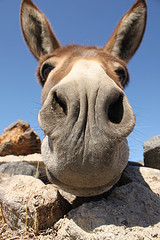
A male donkey is called a jack.
If 5% of our 1.7million web
visitors gave just £2 we could
start Roots to Green Living
projects in 100 UK schools!
Click here:
Or Text 'YPTE05 £2' to 70070 to donate
THE DONKEY – Equus asinus
Donkeys are related to horses and zebras. They are all members of the family ‘equus’, i.e. they are equines. The donkey is a descendant of the African wild ass, which is now rare in the wild and found in only a few remote parts of north-eastern Africa.
Wild donkeys
There are still several types of donkey living wild in various parts of the world including: the ‘Kiang’ in India and Nepal the ‘Somali’ wild ass in Africa the ‘Onager’ in Mongolia, Turkestan, Iran and Syria. Most wild donkeys stand between 102cm (10 hands) and 142 cm (14 hands).
Adaptations:
In the wild, donkeys do not live in such close herds as horses and ponies do as they occupy marginal desert-lands where food is generally scarce. As a result they have developed very loud ‘voices’, which can carry just over three kilometres. This allows them to keep in contact with one another. Their larger ears also allow them to hear the distant calls of their neighbours. Donkeys also use their ears as a form of visual communication and they may help dissipate some of the hot desert heat.
Donkeys have a very tough digestive system that can break down almost inedible vegetation and at the same time extract and save as much moisture as possible.
Domestic donkeysSizes:
Donkeys range in size from the Miniature Mediterranean (under 91cm) to larger donkeys such as the rare French Poitou (up to 150cm) with its large head and ears and thick, shaggy coat. Domestic donkeys tend to be classified by their size rather than breed as over the generations breeds have been crossed and as a result, there are not many pure breeds left.
The size categories are:
Miniature Under 91 cm ( 9 hands)
Small Standard 91 - 101 cm ( 9 -10 hands)
Standard 101 - 122 cm (10 -12 hands)
Large Standard 122 - 142 cm (12 - 14 hands)
Mammoth Jacks Over 142 cm (over 14 hands)
Colours:
Although many donkeys are the familiar grey-dun (mouse grey) colour, there are many other coat shades – there are spotted donkeys, black, white, every shade of grey and brown and albino-white. They can also be of a pink colour (light red mixed with grey-dun), more technically known as ‘strawberry roan’.
Age:
Donkeys often live for twenty-five years or more. Some have been recorded as living to the ripe old age of sixty, although a forty-year-old donkey is considered to be elderly.
A donkey/horse comparison
Why do people keep donkeys?
A donkey can have many uses; here are just a few:
Protect sheep/cattle & goats
Once a donkey has bonded with a herd it will protect them against canine predators (foxes, dogs, coyote) as it would one of its own. It beds down with the animals at night and on hearing any strange noises will voice a warning to the herd and chase, often trampling, the predator.
Foal or stable companion
The donkey seems to have a calming effect on horses. It can be introduced to a mare and foal and on separation from its mother the foal looks to the donkey for support. In a similar way a donkey can be an excellent field or stable companion to a nervous horse.
Handicapped riding programmes
The donkey is widely used in riding for the disabled due to its affectionate and kind, patient nature.
Working donkeys
There are very few working donkeys in Britain today, however, in many developing countries a donkey is a person’s most prized possession being used to pull loads and carts and to work mills and wells.
Some interesting donkey facts:
A male donkey is called a jack.
Hands – a measuring unit used for equines that is equal to four inches.
Laminitis – also known as ‘fever in the feet’. It is an inflammation of the sensitive tissue lining the inside wall of the foot. It can occur at any time of the year but more often occurs in spring with the growth of the rich, new grass.
