
Download this Factsheet as a PDF


A random image

Horse (Przewalski's)

Przewalski's horse: Equus caballus przewalskii

przewalski's horseDistribution: probably extinct in the wild. Once found from Ural mountains to Mongolia. A few may still exist on plains either side of the Altai mountains on boarders of Mongolia, Sinkiang and Siberia.

Habitat: originally roamed mountainous, arid, semi-desert country with large, grassy plains.


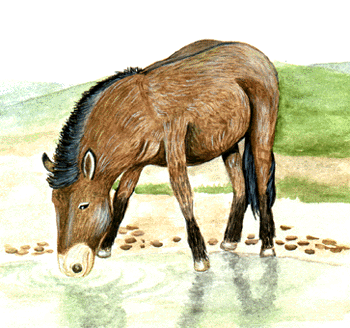
Description: stocky body; low set shoulders which blend directly into the back, giving the horse a primitive look. Yellowish-brown coat, paler undersides, pale sandy-coloured muzzle, black tail and lower leg. Thick woolly coat in winter. The mane has no forelock but has short, stiff, black hairs which stand upright. Size: average height to withers is 12 hands i.e. 1.2m to shoulders. Weight: about 350kg.

Life-span: up to about 25 years.

Food: grass and leaves from shrubby trees.

Przewalski's horse (pronounced 'pris-vaal-ski') is the only truly wild horse left in the world. It is believed that it has changed very little since the end of the Ice Age and is probably the ancestor of all modern horses. It was discovered and identified in 1881 by a Russian cavalry officer and explorer, Colonel Nicolai Przhevalsky, after whom the horse is named. Obviously, local people had known it for generations before this time. Unfortunately, Przewalski's horse can now only be seen in zoos.

Przewalski's Horse Habits

Feeding in its former habitat: Przewalski's horse used to roam the vast grassy plains of Eurasia in large herds. Over the centuries, the herds became smaller and eventually restricted to the dry, semi-desert plains on the other side of the Altai mountains, known as the Mountains of the Yellow Horses, which form the boundary between Mongolia and China.

In the wild, the horse survived on coarse grasses, branches and leaves from hardy trees growing on the harsh plains. It fed mainly at dusk, always on the move as it searched for food. During the winter it often had to scrape away layers of snow to find anything to eat.

At dawn, the herds returned to a desert habitat to rest until the evening. As the horses moved between resting and feeding areas, they walked in a line, forming deep, well trodden paths.

Breeding: in the wild, a Przewalski's horse herd would be made up of a stallion, a few mares and young horses. Mating occurs in April or May and a single foal is born almost a year later. The foal is usually born during the night and by the morning it is strong enough to travel with the herd. If a foal lags behind, particularly if the herd is fleeing from danger, the stallion grasps the root of the foal's tail and encourages it along.

The foal is capable of grazing within a few weeks but the mare suckles it for several months, perhaps until she gives birth again. A female foal (a filly) may remain with the herd for some time. The stalion drives young males out after a year and they group up in small herds until they are about three years old, strong and mature enough to collect a harem of mares.

Przewalski's Horse and Man

For centuries, this horse was hunted by the Chinese and Mongolians as a source of food, and the decline of the species was speeded up when firearms reached the hands of these hunters.

Having such a wild, shy nature, the Przewalski's horse has never really been tamed by man, and has only been semi-domesticated. When still in the wild, it had been allowed to breed with feral horses (i.e. formerly domestic horses now living wild).

This unique horse has been saved from total extinction through captive breeding in zoos, such as Marwell Zoo, near Winchester in Hampshire. A studbook listing the horses and their ancestors helps zoos exchange animals to prevent inbreeding. There are now more than 600 horses in captivity and a breeding programme means that some animals can be reintroduced into suitable areas in the wild, in nature reserves in the USSR, China and Mongolia.