
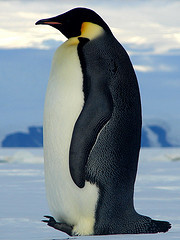
Penguin (Emperor)
Emperor Penguin: Aptenodytes forsteri
Distribution: Antarctica.
Habitat: Lives only on pack ice and in the surrounding oceans.
Size: Emperor penguins measure around112cm. in length and they weigh anything from 20 - 40kg.
Lifespan: Roughly 20 years.
Diet: Fish, crustaceans and squid.
Description: This is the largest species of penguin and it is the size and the colourful plumage of this species which makes it so attractive and popular. Its head, back and upper wing surfaces are black; its belly and underwing surfaces are white. There is an orange patch close to the ear, yellow colouring at the throat and a lilac-coloured line along the edges of its long and slender bill.
Territory: Emperor penguins are very sociable creatures and live in colonies of anything from five hundred to twenty thousand pairs of penguins. It is very rare to find an emperor penguin living outside Antarctica. Although emperor penguins will only feed at sea they will travel over 100km inland to find suitable breeding sites.
Daily Life
Despite looking ungainly on land, once in the water the emperor penguin becomes an efficient predator. The streamlined shape of a penguin's body means that, although this species only reaches speeds of around 6-8km per hour, it can change direction and twist around quickly when chasing its prey.
The emperor penguin can claim to hold the world record for the deepest-diving bird. In 1969 a team of American scientists established that the emperor dives to depths of 265 m (869 ft). This penguin can also stay underwater for 18 minutes which is far longer than any other bird.
Breeding
Unlike most species of birds the emperor penguin lays its eggs during the harsh Antarctic winter months of May or June. This is remarkable when one remembers that at that time of year temperatures may be as low as - 40 degrees Celcius, with winds of 90mph or more. These are, in fact, two of the reasons why emperor penguins do travel so far inland to reach breeding sites, called rookeries.
Rookeries are usually situated at the base of permanent ice cliffs which offer some shelter from the freezing weather. The ice from these cliffs must not melt until the chicks are fully fledged which can take until the early summer months (November in the southern hemisphere). This is why emperor penguins will travel so far inland to breed.
As soon as the egg is laid it is passed to the male who carefully balances it on his feet and then covers it with an abdominal fold of skin. Almost immediately then, the female leaves the male and joins other females from the colony as they make their way back to the sea to feed up. The males are simply left "holding the baby" for up to two months.
Without the warmth and protection provided by the male's body and the insulation provided by the feet, the chick inside the egg would quickly die, and so the male penguin has to remain where he is until either the egg hatches or the female returns. Often the males will huddle in large groups for protection against the icy winds and storms. They have no means of obtaining food during this period and so they live on their resources of fat. Movement is limited to a few careful steps (with the egg still balanced on the feet).
The female remains at sea for about seven or eight weeks before returning, well fed, to the colony. She is able to locate her mate despite the large number of now very emaciated males present and she then takes over the final stages of incubation.
It is an amazing fact that if the chick hatches before the female returns the male is able to feed it by a process of regurgitation despite the fact that the penguin has not eaten for weeks.
With the female safely back with the chick the male can now head (weakly) for the sea himself in order to feed heavily and put on the numerous pounds he has lost during the arduous period of incubation.
Emperor Penguins and Man
Until the late 20th century man hunted penguins for their fat which was used to produce oil. Being the largest of the seventeen species, the emperor penguin was particularly targeted. However, the only creatures that hunt this penguin now are the leopard seal and the killer whale.
At present the emperor penguin population is growing steadily. This is probably due to a decline in the whale population which has reduced the competition for food.