
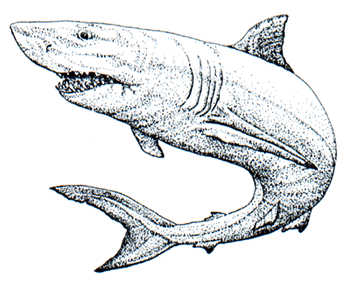
Shark (Great White)
Great white Shark: Carcharodon carcharias
Distribution and Habitat: Oceans all over the world, but prefers warm or temperate seas. A few have been found in cooler waters off Iceland, Nova Scotia and South Australia.
Size: Length:- 3 - 6m, sometimes much longer. Weight:- 1200 kg average. Females are larger than males.
Lifespan: Not certain, but probably 30 - 40 years.
Food: Almost any large fish or warm-blooded animal.
The great white shark has long had a reputation as a fearsome 'man-eater' and is probably the most feared of all animals that live in the oceans. This huge predatory fish is certainly superbly adapted to its role as an ocean killer!
The great white shark is constantly on the move, swimming slowly and continously, beating its tail from side to side. It mostly patrols alone, offshore and is rarely found in the open ocean. It can cruise at a steady 3.5 km for days. In temperate seas the great white seems to migrate either northwards or southwards, depending on the hemisphere, as the sea warms in the summer, In winter, when the water is cooler, the shark migrates back again.
Hunting
The great white shark is known to live mainly on large fish such as tuna, marlin and broadbill swordfish. As well as these fast - swimming species it will also catch sluggish bottom-dwelling skates and rays. Seals, dolphins, sea lions and turtles also often fall victim. sharks have an acute sense of smell, enabling them to find their food. The surface of the snout has thousandsof tiny holes which make up an important sensory organ which allows the shark to sense minute drops of blood in the water. It can detect a tiny drop of blood in 4,600,000 ltres of water. The shark can see and hear very well which also helps it to locate its prey. In fact two thirds of the shark's brain area is devoted to the vital sense of smell.
A shark usually hunts alone but several may home in on prey if it is releasing blood into the water. the sharks themselves can find they are in danger during a "feeding frenzy" for when attacking, a hungry great white goes straight towards the prey and may lunge through the water at up to 50mph - and woe betide any shark which gets in the way! Mahy sharks are bitten by their own comrades during mass attacks at a "feeding frenzy".
As the shark opens its mouth to attack, it raises its flexible snout out of the way and the jaws, which are loosely attached to the skull, are pushed out as the mouth opens which puts the teeth into the biting position. The power behind the jaws is imense and the teeth are adapted for shearing or sawing flesh as a shark clamps its jaws on its victim and throws its head from side to side until a mouthful is torn from the body. Even quite a a modest-sized 4.8 metre (16 foot) great white shark can bite with a pressure of 3 tonnes per square centimetre, and will tear out a chunk of flesh measuring 28 by 33 centimtres.
The teeth of sharks are formidable - and a close-up photograph of the open mouth of a great white shark can be spine-chilling to say the least! The teeth are triangular and have serrated edges for tearing flesh. They are not rooted into the gum like those of mammals but are embedded in several rows, one behind the other. New teeth form on the inside of the jaw, lying flat at first but gradually flipping up as they move forward. Only the front row of teeth is functional at any one time. Usually only a few worn-out teeth are lost at a time, at the rate of about one every 8 days or so. Each tooth can measure up to 7.5cm long.
Breeding
Very little is known about the breeding of the great white shark. No pregnant female has ever been caught, but it is thought that reproduction is ovo-viviparous ie. the young are born alive. It is possible that the largest of the young, whilst inside the nother, eat the smaller babies, so that only up to four young are eventually born. The sharks probably have breeding grounds where males and females congregate to mate.
The Great White Shark and Man
The great white shark is at the top of the oceanic food chains and has no natural enemies - apart from man. Sharks are difficult animals to study; the great white is always on the move and it is impossible to keep in captivity. Also, because it is a top predator, it matures late and reproduces slowly, with the result that the overall population is small and scattered over a wide area. Man, in his often relentless efforts to kill the feared great sharks, can sometimes forget that these predators have an important role to play in maintaining the balance of life in the seas. They catch weakly and sick animals which helps to keep the fish stocks strong and healthy. Also, the predatory sharks ensure that no one species of fish becomes too numerous. If all, or most of the sharks were killed, the food chains would be severely affected.
Modern underwater photographic equipment has allowed us to study sharks in more detail and to appreciate their wonderous adaptations to their way of life. We have also gained some insight into reasons why certain species will attack humans, if given the chance. The great white shark is certainly likely to regard a swimming human as a tasty snack! It is often found in quite shallow water and, unlike other dangerous species of charks, if attracted to a swimmer or diver it does not approach and carefully investigate before attempting to bite, but rushes in before the hapless victim realises what is going on!
All the same, despite its evil reputation, great white shark attacks are not always fatal. In fact, only about a third of attacks on people prove fatal. Most victims manage to reach safety, but usually, as can only be expected, in a badly mauled condition. An adult human is too big for a great white to swallow whole, and an attacking shark will usually take a bite - a very large bite - out of the body, just as it would do to an adult sea-lion. Surfers are particularly at risk from great white attacks probably because the shark mistakes people paddling on noards for a sea-lion or seal.
The great white shark has, for many years, been seen as the greatest prize for rod-and-line fishermen, especially since Peter Benchley's novel Jaws was made into a series of popular films. Many 'sportsmen' thought it was a good for their 'macho' image to go out and kill as many sharks as possible, often with powerhead weapons. This 'sport' became particularly popular around the coasts of Australia and many sharks, including harmless species, suffered as a result. In fact, conservationists have become very concerned that the great white shark has dropped in numbers in some areas of the world and fishing for the species is being restricted or banned. Fishing for the tourist trade (the jaws of a great white can be sold for over one thousand dollars) and sea pollution are additional hazards to the future of this impressive predator.
The great white sharks have lived in the world's oceans for well over 300 million years. We may be right to be afraid of them but these awe-inspiring animals also deserve our respect and admiration.