
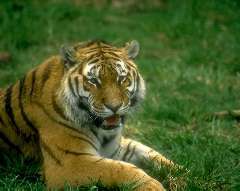
Tiger
Bengal Tiger: Panthera tigris tigris
Length: 1.6 – 2m.
Shoulder height: 0.9m.
Tail: 0.9 - 1m.
Weight: 120kg - 280kg
Life span: 20 - 25 years.
Gestation: 95 - 114 days (1-5 in a litter).
Distribution: India, Bangladesh, Nepal, Sikkim, Bhutan and Burma.
Habitat: Jungle, reedy swamps.
Diet: Flesh (wild pig, deer, buffalo).
The tiger is the largest member of the cat family, and the Bengal tiger is one of the five surviving races of tiger. They have been protected since 1972, which means that it has been illegal to hunt them or to buy or sell goods made from any part of a tiger. In 1900 there were about 45,000 Bengal tigers in the wild. It is thought that today there are less than 1,500.
The clearance of forests, an increasing human population and a greater demand for tiger products have all contributed to the tiger's decline. Most tigers are now protected and living in reserves, so the destruction of their habitat is not so great a danger, but as tigers become rarer, the value of a dead tiger has increased. A single tiger might be worth as much as US $50,000 on the black market by the time its skin, bones and organs have been sold to dealers. It is thought that the illegal trade in tiger parts brings in US $25,000,000 per year, so it is a very serious problem.
India's National Parks are being mismanaged, and there are not enough guards to stop the poaching of tigers. The guards are also very badly equipped, which means that if they do come across any poachers, the poachers are likely to be far better armed than the guards anyway. This makes life very dangerous for the guards and a great deal easier for the poachers.
Even villagers are prepared to have a go at poaching. The rewards are huge, and punishments are not severe enough. Tigers are rarely killed with guns, as a bullet hole affects the value of the skin. Instead they are baited with poisoned meat, which means that the tigers die a slow and agonising death which sometimes takes several days.
Tiger parts are used extensively in Chinese medicine. They are thought to help cure rheumatism, scabies and boils amongst other things, but there is no medical evidence to support these claims. It is to China and Taiwan that most illegal tiger parts are sold. India could make around US $30,000,000 each year from tourists who come to India specially to see wild tigers. This is US $5,000,000 more than is made by the illegal trade in tiger parts, yet still people are prepared to kill them. In a few years time, there could be no tigers at all, which would mean that India would get no income whatsoever from tigers, so protecting tigers now is economically as well as morally correct. Action needs to be taken now. The National Parks need more, better-equipped guards backed by stiffer penalties for poachers who are caught.
Tiger Numbers
There are currently thought to be less than 3,500 tigers left alive on the planet. The Caspian tiger, Javan tiger and Bali tiger are considered to be extinct
Some African lions have been poached for their bones. Leg bones of lions closely resemble those of tigers, and as tigers are becoming rarer, it seems that poachers are starting to explore the possibilties of selling lion bones to the Chinese medicine market. So if the tiger is wiped out, there is a good chance that other big cat species will follow.
Tiger Habits
Tigers live alone and move chiefly at night. If there are large animals to feed on then they make a kill about twice a week, but they have to kill more often if only small animals are available. They prefer deer, wild pigs and wild oxen, but will also eat all kinds of mammals, birds, reptiles and fish.
Tigers may cover an area of 20 miles in one night's search for food. They make every effort to avoid contact with humans though hungry tigers may attack domestic cattle, and a sick or lame tiger may even attack a human if they are unable to catch swifter-moving prey.
Females only have cubs once every two and a half years and there is no special mating time or breeding season. Tigresses start to breed between two and four years of age. Cubs remain with their mother until they are two years old.